
Surfactants are often called “industrial MSG” and play a core role in cleaning, cosmetics, textiles, and industrial processing. This article takes you deep into the microscopic world and basic theories of surfactants.
Surface tension is the contractile force per unit length on the surface of a liquid, measured in N/m. Simply put, it is the force that minimizes the surface area of a liquid.
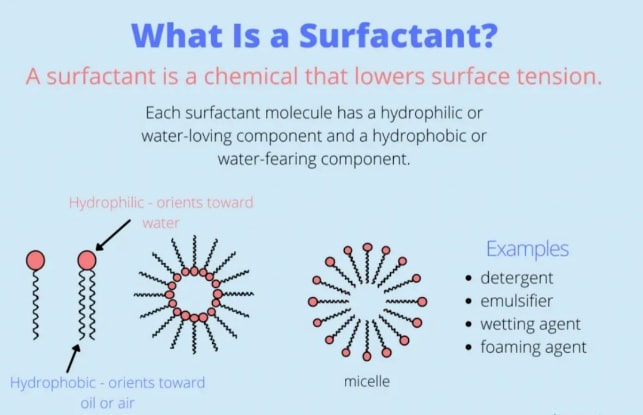
The property of reducing the surface tension of a solvent is called surface activity. Substances that can form micelles in aqueous solutions and possess wetting, emulsifying, foaming, and washing properties are called surfactants.
The unique feature of surfactant molecular structure is its “Amphiphilic” nature:
When the surfactant concentration reaches a certain level, molecules associate to form aggregates called micelles. The lowest concentration at which micelles form is called the Critical Micelle Concentration (CMC).
Significance: Washing efficiency increases dramatically at the CMC. Generally, detergent concentration should be above the CMC for optimal performance.
The HLB value indicates the balance between the hydrophilic and lipophilic capabilities. Higher values mean stronger hydrophilicity; lower values mean stronger lipophilicity.
| Value | Application | Emulsion Type |
|---|---|---|
| 1.5 ~ 3 | Defoamer | W/O |
| 3.5 ~ 6 | Emulsifier | W/O |
| 7 ~ 9 | Wetting Agent | – |
| 8 ~ 18 | Emulsifier | O/W |
| 13 ~ 15 | Detergent | – |
Washing is not just wiping; it is a complex physicochemical process:
The cleaning solution lowers surface tension, penetrating fibers and spreading over dirt.
Lipophilic tails attach to oil, hydrophilic heads point to water. Mechanical force rolls oil into beads, lifting them off the surface.
Clean Chemical offer a full range of surfactant solutions covering all HLB values and applications.
Contact Our ExpertsCopyright © 2013 ZHENGZHOU CLEAN CHEMICAL CO.,LTD | 郑州市克林化工有限公司 All rights reserved