
First commercialized on an industrial scale in the 1990s, Alkyl Polyglucoside (APG) represents a breakthrough in eco-friendly chemical synthesis. Derived primarily from natural, renewable starch glucose and fatty alcohols, APG addresses the severe environmental and petroleum-depletion drawbacks associated with conventional synthetic surfactants.
Synthesized via direct glucosidation or transacetalization, APG is recognized globally as a truly “world-class” green nonionic surfactant. It seamlessly combines the performance benefits of traditional nonionic and anionic surfactants without inheriting their typical ecological toxicity or processing limitations.
APG exhibits remarkable physical and chemical properties that elevate it above standard ethoxylated surfactants:
Delivers exceptionally low surface tension, rapid wetting, rich and stable foam, and outstanding synergistic performance when blended with co-surfactants.
Maintains complete solubility and high surface activity even in highly concentrated acid, alkali, and electrolyte solutions without experiencing cloud point or gelation.
Demonstrates exceptionally low oral and dermal toxicity, minimal skin and eye mucous membrane irritation, and rapid 100% biological degradation.
Formulated entirely from natural plant carbohydrates and fatty alcohols, reducing industrial dependency on refining finite petrochemical resources.
Alkyl Polyglucoside is the condensation reaction product of glucose (or starch carbohydrates) and higher fatty alcohols. Its general chemical formula is represented as:
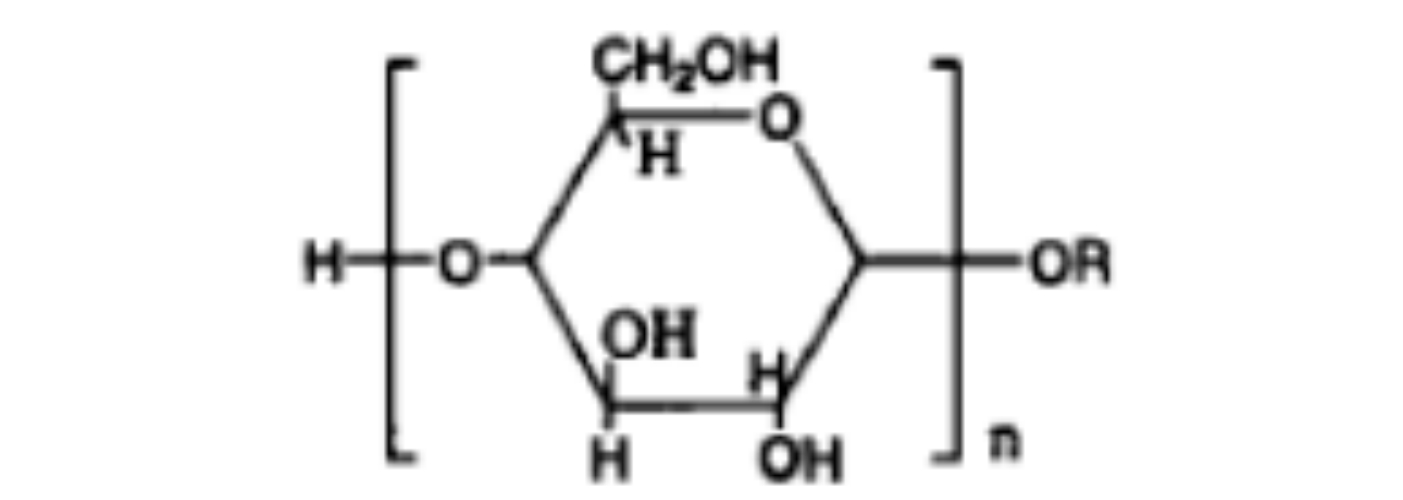
Figure 1: Molecular structural representation of Alkyl Polyglucoside (APG), where R represents the fatty alkyl chain (C8–C16) and n denotes the average degree of polymerization.
The performance profile of APG is heavily dictated by the carbon chain length (R) and the average degree of polymerization (n):
Pure APG is a white, glass-like powder with a broad melting range starting from its softening point. Commercial technical-grade APG products are supplied as light yellow to brown, highly hygroscopic aqueous solutions or solids due to refining variations.
| Performance Metric | APG Performance Profile | Comparative Benchmark (vs AES / LAS / AEO) |
|---|---|---|
| Acid & Alkali Tolerance | Excellent stability in strong acids, alkalis, and 20%–30% inorganic salt solutions. | Far superior to conventional nonionics (AEO) which suffer from low cloud points. |
| Foam Characteristics | Rich, dense, and stable fine bubble structure; optimal at C10.3 alkyl chain length. | Outperforms AES (SLES) and LAS in foam stability and rinseability. |
| Hard Water Resistance | Maintains moderate-to-high foaming power, though slightly sensitive to extreme water hardness. | Higher hard-water resistance than pure LAS; excellent when blended with LAS. |
| Solubility & Rheology | Soluble in water, insoluble in typical non-polar organic solvents; no gel phase creation. | Eliminates the need for toxic co-solvents (such as hydrotropes) in liquid detergents. |
Traditional kitchen and laundry detergents rely heavily on LAS/AEO blends. However, these systems require hydrotropes (e.g., amine oxides) due to limited solubility and mildness. Replacing or co-formulating LAS with APG dramatically reduces the Critical Micelle Concentration (CMC), enhances grease removal, yields a comfortable rinse feel, and eliminates spot residues on dishware.
Dermatological tests verify that APG exhibits minimal irritation to human skin, corneal mucous membranes, and living cells. APG serves as a high-performance emulsifier, moisturizer, and skin softener in creams and lotions. Furthermore, co-formulated with waxes or fatty esters, APG creates stable pearlescent dispersions for luxury cold-processed shampoos.
APG functions as an eco-friendly pesticide emulsifier, dispersant, and herbicide adjuvant. Due to its exceptional wetting and penetrating action, APG enhances the active ingredient coverage and biological absorption across plant foliage surfaces while ensuring zero soil or crop accumulation.
In biochemical processing, APG solubilizes and stabilizes delicate membrane proteins without triggering denaturation due to its high UV transparency. In plastics manufacturing, APG serves as an additive in polyol-initiated polyurethane foams, significantly improving flame retardancy and thermal stability.
A: While SLES (AES) and LABSA serve as cost-effective primary foaming and cleansing agents, APG acts as a premium green co-surfactant. Adding APG reduces the irritation profile of SLES/LABSA, improves hard-water performance, and enhances foam creaminess.
A: Yes. Although APG is chemically stable, its remaining three free hydroxyl groups on the glucose ring allow for further esterification, etherification, alkoxylation, and quaternary ammonium cationization to yield custom functional surfactants.
Seeking high-purity Alkyl Polyglucoside (APG), SLES 70%, LABSA 96%, or municipal water treatment chemicals? Get in touch with our technical sales engineers for technical datasheets (TDS), safety documentation (MSDS/COA), and competitive factory-direct pricing.
Zhengzhou Clean Chemical Co., Ltd.
Core Production Scope:
📧 Email: info@cleaningent.com
🌐 Website: www.zzcleanchem.com
Henan Tokai Chem Co., Ltd.
Core Production Scope:
📧 Email: info@hntktcca.com
🌐 Website: www.hntktcca.com
Copyright © 2013 ZHENGZHOU CLEAN CHEMICAL CO.,LTD | 郑州市克林化工有限公司 All rights reserved