
Sodium Laureth Sulfate (SLES) is an essential anionic surfactant utilized across personal care and home hygiene formulations. Renowned for its balanced cleansing capacity, dense lather creation, high aqueous solubility, and exceptional formulation flexibility, SLES serves as a reliable cleansing base. When combined with amphoteric surfactants like Cocamidopropyl Betaine (CAB), SLES achieves superior skin mildness while maintaining cost efficiency in industrial mass production.
Sodium Laureth Sulfate, universally abbreviated in the chemical industry as SLES, is classified as a primary anionic surfactant. In industrial manufacturing, SLES is produced using lauryl alcohol as the starting raw material, undergoing sequential ethoxylation modification, sulfation reaction, and neutralisation with sodium hydroxide to achieve high-purity refinement.
The resulting SLES molecule possesses an amphiphilic structure containing both hydrophilic (water-attracting) and lipophilic (oil-attracting) functional groups. The lipophilic tail absorbs skin sebum, hair oils, and environmental particulate matter, while the hydrophilic head binds with rinse water to lift and carry away impurities. Compared to traditional soap bases that carry higher irritation profiles, SLES exhibits milder physicochemical properties, high tolerance during formulation blending, and superior cost-effectiveness for commercial large-scale production.
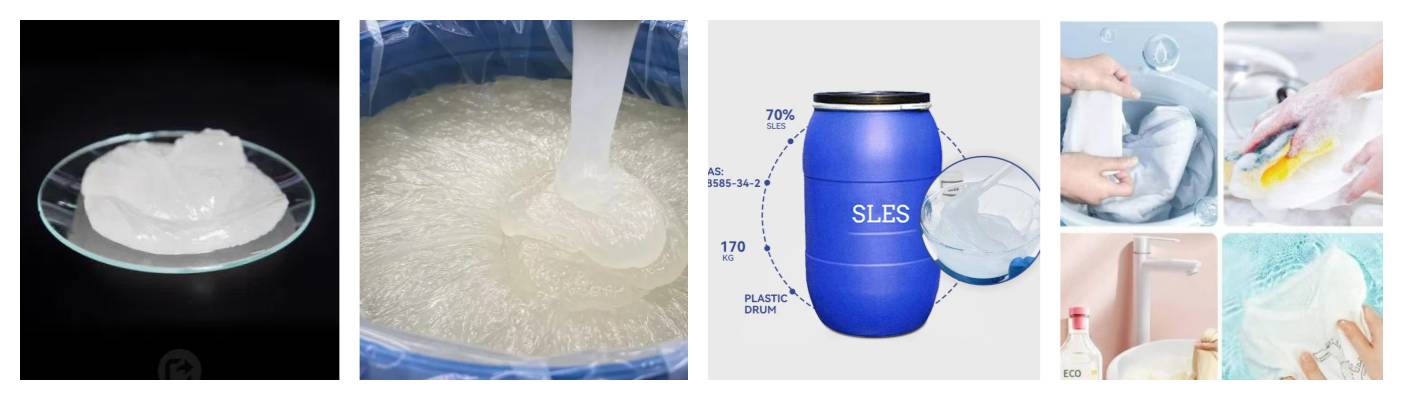
The action of SLES relies on its classic amphiphilic structural profile. Upon contact with dirt and sebum, the lipophilic hydrocarbon chain aligns toward and wraps around grease molecules. Simultaneously, the hydrophilic ethoxylated sulfate group faces outward toward the aqueous phase. Upon mechanical agitation (rubbing or massaging), the oil droplets are detached from skin or hair surfaces into the water phase, forming stable micelles that are easily rinsed away.
Suitable Skin Types: Normal, oily, and combination skin types can use SLES-based formulations safely. For dry or sensitive skin profiles, formulations properly balanced with humectants and soothing co-surfactants provide effective everyday cleansing without discomfort.
Target Users: Consumers seeking daily facial cleansing, hair care, and body wash solutions, especially individuals exposed to dusty environments or elevated sebum production.
| Product Category | Recommended Addition Concentration | Formulation Objective |
|---|---|---|
| Facial Cleansers & Foams | 8% – 15% | Provides mild cleansing while preserving delicate facial skin barrier integrity. |
| Shampoos & Body Washes | 10% – 20% | Delivers elevated oil removal, dense foam, and thorough scalp/body cleansing. |
| Hand Washes & Home Hygiene | 5% – 15% | Ensures fast dirt breakdown and easy rinsing for daily hand sanitation. |
In modern chemical formulating, SLES is rarely used in isolation; instead, it is blended with secondary surfactants to optimize performance:
Common Product Applications: Facial cleansing milks, foaming facial washes, shampoos, hair conditioners, shower gels, household hand soaps, and mild liquid laundry detergents.
A: Yes. SLES has been rigorously evaluated and used globally for decades. In properly formulated products containing balanced co-surfactants, SLES provides safe, effective daily cleansing.
A: SLES undergoes an additional ethoxylation process during synthesis, making its molecular structure larger and significantly milder to the skin and eyes than un-ethoxylated SLS.
Partner with our corporate group for certified quality, consistent bulk supply, and technical consultation across detergent, base, and water treatment chemistry.
(Parent Company)
Core Production Scope: Specialist manufacturer of Detergent Raw Materials (SLES 70%, CAB 35%, LABSA, SLS, CDEA), Base Industrial Chemicals, and Water Treatment Chemical products.
📧 Email: info@cleaningent.com
🌐 Website: www.zzcleanchem.com
(Subsidiary Company)
Core Specialization: Specialist Supplier and Global Distributor focused exclusively on High-Purity Water Treatment Chemicals (TCCA / SDIC Disinfectants).
📧 Email: info@hntktcca.com
🌐 Website: www.hntktcca.com
Copyright © 2013 ZHENGZHOU CLEAN CHEMICAL CO.,LTD | 郑州市克林化工有限公司 All rights reserved