
Surfactants are versatile chemical compounds that reduce surface tension between two liquids or between a liquid and a solid. From industrial detergents to advanced water treatment solutions, Zhengzhou Clean Chemical Co.,ltd (specializing in detergent chemicals, basic chemistry, and water treatment chemicals) and its subsidiary Henan Tokai Chem Co., Ltd (focusing on premium water treatment chemicals) leverage surfactant science to deliver high-performance formulations. Below we explore the six fundamental functions of surfactants with precision and real-world applications.
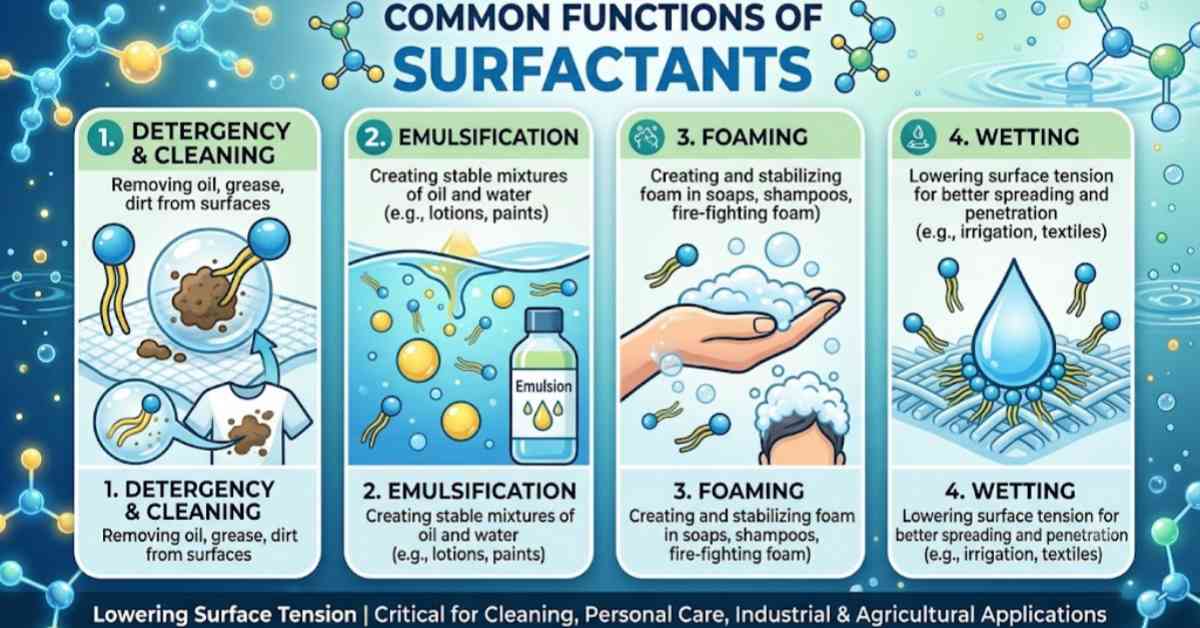
When a solid contacts a liquid, the original solid/gas and liquid/gas interfaces are replaced by a solid/liquid interface – this is wetting. In textile processing, fibers have enormous surface areas and porous structures; surfactant solutions spread along fibers, displace air, and penetrate fiber interiors. This dual action of wetting and penetration ensures even treatment and cleaning. Our parent company provides highly efficient wetting agents and penetrants for textiles, agrochemicals, and industrial cleaning.
Oil droplets dispersed in water tend to coalesce rapidly due to high interfacial tension. With surfactants, the hydrophobic tails adsorb onto oil droplets while hydrophilic heads face water, forming a stable barrier. This reduces the work needed for dispersion and yields long-term emulsion stability. Emulsifiers produced by Zhengzhou Clean Chemical are critical in metalworking fluids, cosmetics, and pesticide formulations. For water treatment applications, Henan Tokai Chem offers emulsion breakers and demulsifiers tailored to oil-water separation in industrial effluents.
Thanks to the emulsifying and dispersing power of surfactants, oily soils and particulate dirt detached from solid surfaces become stably dispersed in the washing solution, preventing redeposition. This detergency mechanism lies at the core of modern laundry powders, dish soaps, and industrial cleaners. Zhengzhou Clean Chemical Co.,ltd manufactures premium anionic and nonionic surfactant blends that maximize detergency even in hard water conditions, ensuring superior cleaning results for institutional and household use.
Dispersion is the process of distributing fine insoluble solid particles uniformly throughout a liquid medium. Surfactants used as dispersants adsorb onto particle surfaces, creating electrostatic or steric repulsion that prevents sedimentation or agglomeration. In many cases, the same surfactants that emulsify oils also disperse solids – that’s why we often combine the terms emulsifier/dispersant. Our subsidiary Henan Tokai Chem Co., Ltd provides advanced dispersants for water treatment (slurry conditioning, scale inhibition) and pigment industries.
Solubilization occurs when surfactants increase the solubility of poorly soluble or insoluble substances in water. For instance, benzene solubility in water is only 0.09% (v/v), but with sodium oleate surfactant, it can rise up to 10%. This phenomenon is driven by micelle formation – above the critical micelle concentration (CMC), surfactant molecules spontaneously assemble into hydrophobic cores that can encapsulate nonpolar solutes like oils, minerals, and organic compounds.
⚠️ Key distinction: Solubilization produces a thermodynamically stable, single-phase isotropic solution, whereas emulsions are kinetically stable multiphase systems. Our surfactant product lines for industrial cleaning and water treatment achieve remarkable solubilization of organic contaminants, aiding in formulation clarity and enhanced bioavailability of actives.
When surfactant molecules align in a directional order on fabric surfaces, they reduce the relative static friction coefficient. Nonionic surfactants such as linear alkyl polyoxyethylene ethers and cationic surfactants are excellent fabric softeners. Branched-chain or aromatic-ring surfactants do not pack uniformly and thus lack softening performance. Zhengzhou Clean Chemical supplies specialized softening agents for textile finishing and home care, ensuring smooth, antistatic, and luxurious fabric touch.
| Function | Mechanism Brief | Key Applications | Company Product Focus |
|---|---|---|---|
| Wetting / Penetration | Reduces contact angle; displaces air from porous surfaces | Textile processing, agrochemical sprays, pigment wetting | Clean Chemical: wetting agents for detergents and textile auxiliaries |
| Emulsification | Forms stable oil-in-water or water-in-oil emulsions | Metalworking fluids, cosmetics, pesticide emulsions | Clean Chemical & Tokai Chem: emulsifiers, demulsifiers for water treatment |
| Detergency | Lifts soil and prevents redeposition | Laundry, dishwashing, industrial parts cleaning | Clean Chemical: high-performance surfactant blends for detergents |
| Dispersion | Stabilizes solid particles in suspension | Paints, inks, water treatment sludge control | Henan Tokai Chem: dispersants for water treatment, mineral slurries |
| Solubilization | Micellar encapsulation increases solubility | Pharmaceuticals, oilfield chemicals, detergent builders | Both entities: micellar solubilizers for industrial cleaners |
| Softening | Reduces static & dynamic friction on fibers | Fabric softeners, hair conditioners | Clean Chemical: cationic & nonionic softeners for home care |
Core expertise: Detergent chemicals, basic chemistry, water treatment chemicals. We manufacture high-quality surfactants for industrial & household cleaning, textile wetting agents, and emulsifier bases.
✅ Over 15 years of chemical manufacturing experience
✅ Customized surfactant solutions for detergency and wetting
Specialization: Advanced water treatment chemicals – scale inhibitors, corrosion inhibitors, biocides, and surfactant-based dispersants for cooling water, boiler water, and wastewater treatment.
🌊 Oil-water separation chemicals | Reverse osmosis chemicals | Coagulants & flocculants
By combining the strengths of both companies, we provide integrated surfactant systems that meet rigorous performance demands. Whether you need raw materials for detergent manufacturing or specialized surfactants for water purification, our technical team supports you from lab to production.
A: Solubilization produces a thermodynamically stable isotropic single phase where the solute is molecularly dissolved inside micelles; emulsification gives a metastable heterogeneous system of two immiscible liquids. Solubilization requires surfactant concentration above CMC, while emulsions can form even below CMC but require stabilizers.
A: Zhengzhou Clean Chemical supplies anionic (LAS, AES), nonionic (alcohol ethoxylates, APG), and amphoteric surfactants ideal for high-performance detergents, degreasers, and wetting agents.
A: Yes, our subsidiary develops tailor-made polymeric and surfactant-based dispersants for scale control, particle stabilization, and sludge conditioning in industrial water systems. Contact our team for formulation support.
A: Surfactants improve flotation, demulsification, dispersion of suspended solids, and enhance biocide penetration. Henan Tokai Chem offers eco-friendly surfactants for potable water and wastewater applications.
⚡ Request our latest surfactant technical data sheets, sample evaluation, or volume quotation – Our engineers provide prompt support within 24 hours.
✉️ Email Our Team 💬 WhatsApp Now
Copyright © 2013 ZHENGZHOU CLEAN CHEMICAL CO.,LTD | 郑州市克林化工有限公司 All rights reserved