
Surfactants are fundamental and irreplaceable raw materials in the formulation of modern cosmetic, cleaning, and industrial products. They play critical multi-functional roles across cleaning, emulsification, dispersion, wetting, and rapid foam generation. Depending on the specific electrochemical nature of their hydrophilic headgroups, surfactants are scientifically categorized into four primary groups: Anionic, Cationic, Amphoteric, and Non-ionic.
This technical guide compiles a master glossary of common international surfactant abbreviations and chemical denominations. This reference index is designed to help global procurement managers, chemical distributors, and formulation engineers rapidly identify, cross-reference, and source specific raw materials within their supply chains.
Key Sourcing & Engineering Insights:
*Note for mobile users: Scroll or swipe horizontally to view the full columns of the technical data.
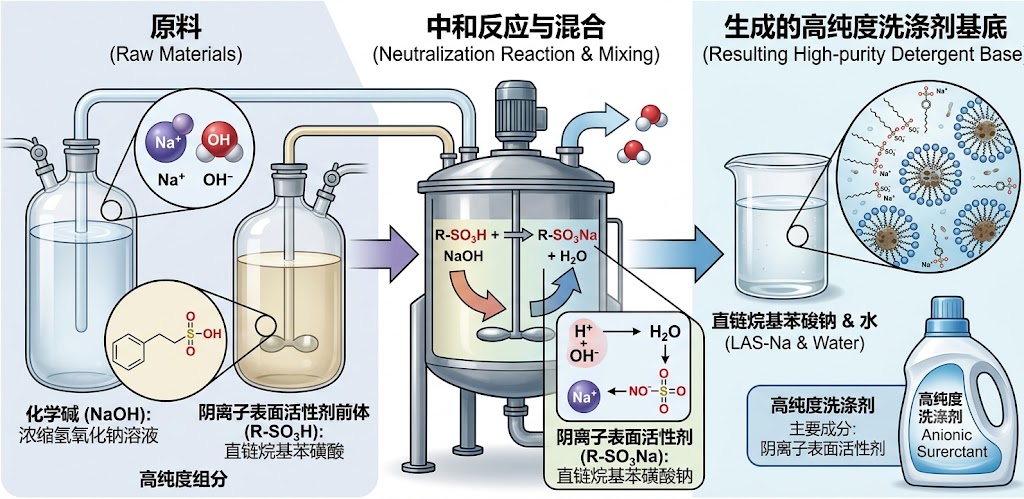
Anionic surfactants, also widely classified as anionic detergents, principally consist of linear alkylbenzene sulfonates, alkyl sulfates, and ethoxylated ether sulfates. They offer heavy-duty wetting, emulsifying, dispersing, and stain removal actions.
| Standard Abbreviation / Trade Code | Chemical Name / International INCI Nomenclature |
|---|---|
| AOS | Sodium Alpha-Olefin Sulfonate |
| AESA-70 | Ammonium Lauryl Ether Sulfate – 70% |
| K12A-70 | Ammonium Lauryl Sulfate – 70% |
| K12A-28 | Ammonium Lauryl Sulfate – 28% |
| K12 / SLS | Sodium Lauryl Sulfate |
| MAP-85 | Monoalkyl Phosphate – 85% |
| MAP-K | Potassium Monoalkyl Phosphate |
| MAP-A | TEA-Monoalkyl Phosphate (Triethanolamine Salt) |
| MES | Disodium Laureth Sulfosuccinate / Fatty Acid Methyl Ester Sulfonate |
| AES-2EO-70 / SLES | Sodium Lauryl Ether Sulfate – 70% |
| TEXAPHON T42 | TEA-Lauryl Sulfate (Triethanolamine Lauryl Sulfate) |
| SAS 60 | Secondary Alkane Sulfonate – 60% |
| SCI 85 | Sodium Cocoyl Isethionate |
| Medialan LD30 | Sodium Lauroyl Sarcosinate |
| Hostapon CT | Sodium Methyl Cocoyl Taurate |
| Hostapon CLG | Sodium Lauroyl Glutamate |
| Ganapol AMG | Magnesium Laureth Sulfate |
| Sandopan LS-24 | Sodium Laureth-11 Carboxylate |
Cationic surfactants are predominantly nitrogen-bearing organic amine derivatives. Because the nitrogen atoms possess lone pairs of electrons, they comfortably form hydrogen bonds with acidic elements, conferring a functional positive charge to the molecule. They are extensively subdivided into amine salts, quaternary ammonium salts, heterocyclic compounds, and oxonium products.
| Standard Abbreviation / Trade Code | Chemical Name / International INCI Nomenclature |
|---|---|
| 1831 | Steartrimonium Chloride / Octadecyl Trimethyl Ammonium Chloride |
| 1631 | Cetrimonium Chloride / Hexadecyl Trimethyl Ammonium Chloride |
| TE-90 | Dihydrogenated Tallowethyl Hydroxyethylmonium Methosulfate |
| EUMULGIN S2 | Ceteareth-2 / BRIJ72 |
| EUMULGIN S21 | Ceteareth-21 / BRIJ721 |
| EUMULGIN B2 | Ceteareth-20 |
| EUMULGIN VL-75 | Lauryl Glucoside & Polyglyceryl-2 Dipolyhydroxystearate & Glycerin |
| DEHYMULS PEG-7 | Hydrogenated Castor Oil Derivatives |
| Emulgade PL 68/50 | Cetearyl Glucoside & Cetearyl Alcohol |
| Emulgade SE-PE | Ceteareth-20 / Ceteareth-12 / Cetearyl Alcohol / Cetyl Palmitate Blend |
| Emulgade 1000NI | Cetearyl Alcohol & PEG-20 Cetearyl Alcohol |
Amphoteric surfactants display both anionic and cationic hydrophilic groups simultaneously on their molecular chains. Their defining functional trait is their pH-dependent amphoteric behavior, acting effectively as ultra-mild, skin-safe surface-active foundations.
| Standard Abbreviation / Trade Code | Chemical Name / International INCI Nomenclature |
|---|---|
| DEHYTON K / CAPB | Cocamidopropyl Betaine |
| BS-12 | Lauryl Betaine / Lauryl Propyl Betaine |
| OA-12 | Lauramine Oxide / Lauryl Dimethyl Amine Oxide |
| CAB-35 | Cocamidopropyl Betaine – 35% Active Matter |
| CHS-35 | Cocamidopropyl Hydroxysultaine |
| CAMA-30 | Cocoamphoacetate / Coco Imidazoline Derivative |
| MES | Disodium Laureth Sulfosuccinate Salt |
Non-ionic surfactants do not release ions in water systems. Their excellent interfacial energy reducing properties are driven by highly polar oxygenated groupings like polyoxyethylene. They offer superior hard water resistance, outstanding calcium soap dispersion, zero chemical irritation, and superb overall wetting and degreasing profiles.
| Standard Abbreviation / Trade Code | Chemical Name / International INCI Nomenclature |
|---|---|
| COMPERLAN 100C | Cocamide MEA / Cocoyl Monoethanolamide |
| COMPERLAN COD | Cocamide DEA / Cocoyl Diethanolamide |
| 600 CSUP (APG) | C12-14 Alkyl Polyglucoside |
| GLUCOPON 650 EC (APG) | C8-14 Alkyl Polyglucoside |
| PLANTACARE 1200 UP (APG) | C12-16 Alkyl Polyglucoside |
| PLANTACARE 2000 UP (APG) | C8-16 Alkyl Polyglucoside |
| AEO-3 / 7 / 9 | Fatty Alcohol Polyoxyethylene Ether (Ethoxylates) |
| TX-4.5 / 6.5 / 10 / 15 / 20 / 40 | Nonylphenol Ethoxylates |
| GENAPOL UD-080 | C11 Oxo-Alcohol Polyoxyethylene Ether |
| CMEA | Cocamide MEA Solid Flakes |
| DEHYPON LS45 | Fatty Alcohol Alkoxylate (Low-Foam / Anti-Foam Ethoxylated Base) |
| UD-080 | C11 Synthetic Oxo-Alcohol Ethoxylate |
In global industrial infrastructure, surfactants are widely cross-utilized outside of traditional retail detergents. In large-scale industrial water purification, circular cooling tower fields, and sewage management, surfactants like AEO-9, K12 (SLS), and specialized non-ionic alkoxylates serve as high-efficiency bio-sludge dispersants and wetting agents. They prevent suspended solids and bio-organic grime from baking onto piping walls, drastically increasing the structural penetration and bio-clearance efficiency of core industrial water treatment biocides and scale inhibitors.
This technical cross-over underlines the profound logistical benefit of cooperating with an integrated industrial partner. By sourcing core surfactant bulk bases together with specialty water treatment agents, global industrial operations can substantially compress operational overhead and optimize chemical compatibility profiles.
Consolidating chemical supply chains requires an established group infrastructure capable of guaranteeing high-purity batch quality, optimized customs management, and swift sea freight delivery.
Parent Company Operations: Focuses on the large-scale R&D, manufacturing, and export of high-tier Detergent Chemicals, Base Chemicals, and advanced Water Treatment Chemical Products. Our primary production portfolio covers staple surfactant bulk bases including SLES (AES), SLS (K12), LABSA, Fatty Alcohols, and CDEA.
Strategic Subsidiary Operations: Dedicated entirely to the development and global marketing of premium Water Treatment Chemical Products. Tokai leading lines feature high-purity TCCA (Trichloroisocyanuric Acid) granules/tablets, SDIC (Sodium Dichloroisocyanurate), and industrial polymeric scale inhibitors.
By coordinating our parent-subsidiary chemical processing operations, we specialize in high-efficiency Consolidated Container Shipments (FCL/LCL). Global procurement teams can load surfactant detergent bases alongside high-purity water treatment disinfection products within a single, fully compliant shipment manifest, lowering oceanic shipping costs and accelerating port clearance cycles.
Q1: What are the primary shipping considerations when ordering SLES 70% vs SLES 28%?
A: SLES 70% is a highly concentrated paste that minimizes ocean freight expenses per unit of active matter, though it requires specific heating/dilution infrastructure on-site. SLES 28% is a pre-diluted liquid solution that removes operational processing stages but results in higher net shipping weight costs.
Q2: Why is APG gaining major traction over traditional petrochemical surfactants?
A: Alkyl Polyglucosides (APG) are 100% bio-derived surfactants generated from eco-friendly corn starch and natural fatty alcohols. They ensure full environmental biodegradability, possess no skin irritation, and remain entirely functional in high-alkalinity industrial cleanings.
Q3: Is it possible to safely mix load surfactant bases and water treatment biocides in one container?
A: Yes. Under our group’s strict international safety management rules, we manage legal mixed-loading solutions for non-hazardous detergent ingredients alongside class-9 or class-5.1 water treatment agents (like TCCA/SDIC tablets), ensuring complete customs compliance worldwide.
Do you require validated Certificate of Analysis (COA) files, complete Safety Data Sheets (SDS), or immediate container-load FOB/CIF price quotes? Contact our sales offices directly through the secure channels below:
🏢 ZHENGZHOU CLEAN CHEMICAL CO., LTD.
Detergent Chemicals, Base Chemicals & Water Treatment Chemicals Division
📧 Email: info@cleaningent.com
🌐 Website: www.zzcleanchem.com
💧 HENAN TOKAI CHEMICAL CO., LTD.
Water Treatment Chemical Products Division
📧 Email: info@hntktcca.com
🌐 Website: www.hntktcca.com
Copyright © 2013 ZHENGZHOU CLEAN CHEMICAL CO.,LTD | 郑州市克林化工有限公司 All rights reserved