
Surfactants (Surface Active Agents) represent a versatile class of amphiphilic organic compounds designed to dramatically alter interfacial properties. Serving as emulsifiers, detergents, wetting agents, dispersants, and biocides, they act as critical performance enhancers across 14 major global industries. By integrating high-tier surfactant bases like SLES and LABSA with advanced water treatment chemicals like TCCA and SDIC, modern manufacturing systems achieve superior product quality, enhanced efficiency, lower resource consumption, and stable environmental management.
Surfactants have shifted from simple household washing components into complex, multi-functional reagents crucial to industrial and agricultural production. They fulfill dozens of distinct roles—operating dynamically as cement water reducers, fabric softeners, leveling agents, dye fixatives, anti-fogging agents, oil displacement formulations, and surface modifiers. Beyond massive utilization in the traditional detergent and cosmetic sectors, surfactants serve as essential process enhancers across high-tech domains and traditional processing plants, proving key to modern product line development and cost optimization.
Applied seamlessly across spinning, weaving, sizing, scouring, dyeing, and finishing. Surfactants function as high-efficiency scouring agents, penetrating agents, levelers, softeners, and anti-static additives. Non-ionics excel in emulsification and wetting, while ionics (such as highly adsorptive cationics) bind securely to negatively charged textile fibers to deliver optimal hand feel, water resistance, and color fixation.
Crucial throughout complex multi-stage tanning protocols. Surfactants facilitate wetting and deep soaking of raw hides, accelerate degreasing, and enhance color leveling during fatliquoring and dyeing. In fur processing, they safely eliminate grease matrices while safeguarding the original structure of animal hair from mechanical or chemical deterioration.
Divided into process chemistry and functional additives. Used dynamically as resin removers in pulp cooking, high-efficiency de-inking formulations for paper recycling, anti-foaming agents, and felt cleaners during sheet formation. In final coatings, they serve as crucial pigment dispersants, lubricants, anti-static agents, and stabilizing agents.
An essential sub-class of clean food additives. Surfactants function as food-grade emulsifiers, defoamers, crystallization controls in sugar refining, and fruit peeling auxiliaries. They stabilize lipid-water matrices, improve sensory qualities, and significantly extend product shelf life and freshness profiles.
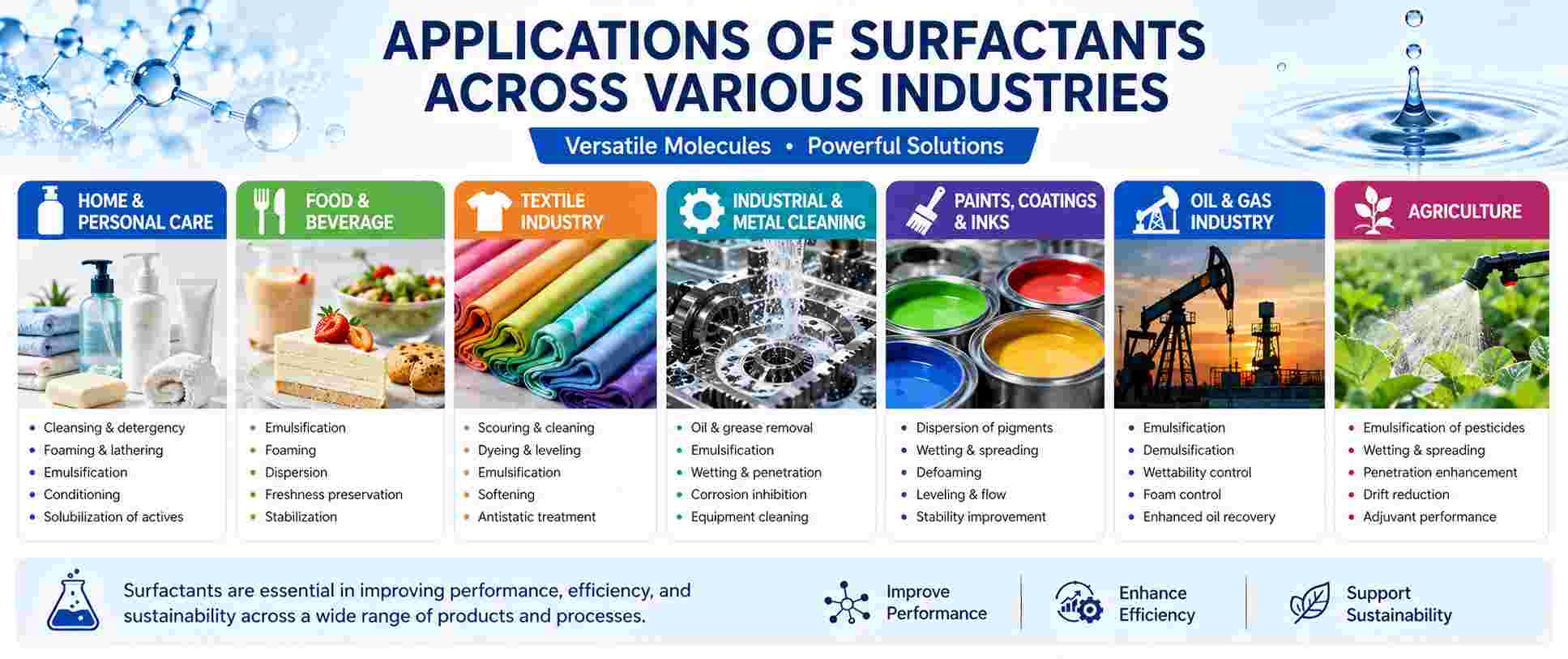
Indispensable as heavy oilfield additives spanning drilling, cementing, oil gas transport, and Enhanced Oil Recovery (EOR). Anionics (including petroleum sulfonates and ether sulfates), non-ionics (polyoxyethylene ethers), cationics, and amphoteric betaines operate as drilling fluid emulsifiers, demulsifiers, corrosion inhibitors, scale preventers, and viscosifiers.
Integral to milling, drilling, grinding, and electroplating. Surfactants formulate degreasing baths that safely strip oils and soil matrices without toxic environmental footprints. They act as acid-mist suppressants during metal pickling, enhance neutralizer diffusion in phosphating, provide cooling lubrication in cutting fluids, and eliminate pitting flaws during electroplating.
Deployed heavily as ore flotation collectors, frothers, and regulators to optimize mineral enrichment. In coal processing, they function as essential mud flotation collectors, dewatering aids, dust suppressants, and critical dispersion stabilizers for high-efficiency coal-water slurries.
Form part of the essential additives block alongside film formers, solvents, and pigments. Surfactants manage the entire life cycle of coatings: working as defoamers and dispersants during manufacturing; anti-skinning agents during storage; leveling/anti-sagging elements during application; and UV absorbers or anti-static agents in final cured films.
Utilized as molecular templates or micro-reactors. The ordered molecular structures of surfactants (micelles, reverse micelles, microemulsions, and liquid crystals) form tight nano-spaces that effectively regulate the size, shape, and monodispersity of growing nanoparticles, while preventing unwanted particle agglomeration.
Accelerates reactions between immiscible aqueous and organic phases through micellar catalysis and phase-transfer catalysis. Surfactants construct highly targeted reaction microenvironments that significantly lower activation energy barriers and optimize overall conversion rates.
Boosts enzyme activity inside organic solvent loops. The polar heads bind securely to the enzyme, dispersing it evenly through the organic phase, while the hydrophobic tails pull target organic substrates inward. This configuration enhances collision frequency and protects enzymes from product-driven inhibition.
The specialized “water pool” cores of reverse micelles mimic the aqueous environments of biological cell membranes. Using dual-hydrocarbon-chain surfactant structures modeled after natural phospholipids allows researchers to isolate, enrich, and study delicate proteins and enzymes without risking denaturation.
Surfactant assemblies (micelles, microemulsions, liquid crystals, vesicles) are engineered as advanced pharmaceutical drug delivery systems. They encapsulate sensitive therapeutic molecules, improve targeted penetration across biological membranes, and accurately control release rates to prevent premature degradation.
Replaces hazardous aromatic solvents (toluene, xylene) in pesticide formulations through advanced microemulsion technologies. Utilizing specialized surfactants like APG, cationic alkyl glycosides, or organic silicon variants boosts active pesticide coverage, improves leaf wetting, and limits broader chemical runoff.
To assist global chemical engineers and procurement officers, the following matrix aligns surfactant classifications with the raw chemical compounds manufactured across our corporate network:
| Surfactant Family | Core Structural Compounds | Dominant Industrial Functions | Primary Supply Alignment |
|---|---|---|---|
| Anionic Surfactants | Alkylbenzene Sulfonates (LABSA), Fatty Alcohol Ether Sulfates (SLES), alpha-Olefin Sulfonates (AOS), Petroleum Sulfonates. | Powerful detergency, rapid wetting, heavy foaming, robust grease emulsification. | Detergent manufacturing, base chemical processing, enhanced oil recovery. |
| Non-Ionic Surfactants | Fatty Alcohol Polyoxyethylene Ethers (AEO), Alkylphenol Ethoxylates (NPE), Alkyl Polyglycosides (APG). | High temperature and salt resilience, premium wetting stability, precise color leveling. | Textile dyeing auxiliaries, paper recycling de-inking, emulsified agricultural concentrates. |
| Cationic Surfactants | Alkyl Trimethyl Ammonium Chlorides, Polyquaterniums, Gemini Quaternary Ammonium Salts. | Surface adsorption, surface anti-static control, fabric softening, biocidal action. | Industrial fabric softeners, anti-static agents, metallurgy corrosion inhibition. |
| Amphoteric Surfactants | Alkyl Betaine, Sulfobetaine, Imidazoline Amphoterics. | Synergistic mildness boosting, wide-spectrum pH stability, complex foam conditioning. | Metal complex levelers, premium personal care, advanced oilfield foaming loops. |
| Water Treatment Oxidizers | Trichloroisocyanuric Acid (TCCA), Sodium Dichloroisocyanurate (SDIC). | Oxidizing biocidal control, algae eradication, organic loading destruction. | Industrial cooling water loops, wastewater systems, pool sanitization. |
A: Emulsification distributes an immiscible liquid into another phase to form an opaque, thermodynamically unstable heterogeneous mixture. Solubilization occurs only when the surfactant concentration rises above the Critical Micelle Concentration (CMC); it encapsulates hydrophobic molecules entirely within micellar cores, creating a transparent, single-phase, and thermodynamically stable homogeneous system.
A: Non-ionic surfactants do not ionize in aqueous solution, making them highly resilient against hard water minerals, heavy salts, and varying pH conditions. This provides superior emulsification stability, uniform surface wetting, and excellent chemical compatibility within complex multi-component formulas.
Managing multi-industry chemical formulations requires verified raw materials and reliable production capacities. Our corporate network delivers premium surfactant foundations and targeted water treatment solutions to global buyers.
Industrial Core Focus: Mass production of high-grade Detergent Chemistry and foundational Base Chemicals, including export-grade SLES, LABSA, SLS, AOS, CDEA, CAB and high-purity cleaning raw materials.
📧 Email: info@cleaningent.com
🌐 Website: www.zzcleanchem.com
Industrial Core Focus: Specialized manufacturing of premium Water Treatment Chemicals, featuring high-efficiency TCCA tablets/granules, SDIC sanitizers, and advanced system scale dispersants.
📧 Email: info@hntktcca.com
🌐 Website: www.hntktcca.com
Copyright © 2013 ZHENGZHOU CLEAN CHEMICAL CO.,LTD | 郑州市克林化工有限公司 All rights reserved